Denver · display faults
Wolf Hood Lights and Indicators
A hood indicator is a counter or a sensor made visible. A filter reminder counts running time rather than measuring grease; a heat response raises the blower on its own because the air under the canopy got hot; a blinking control is the electronics refusing input rather than ignoring it. Wolf Repair Service Denver reads which of the three is happening before touching the canopy: (303) 801-0060.
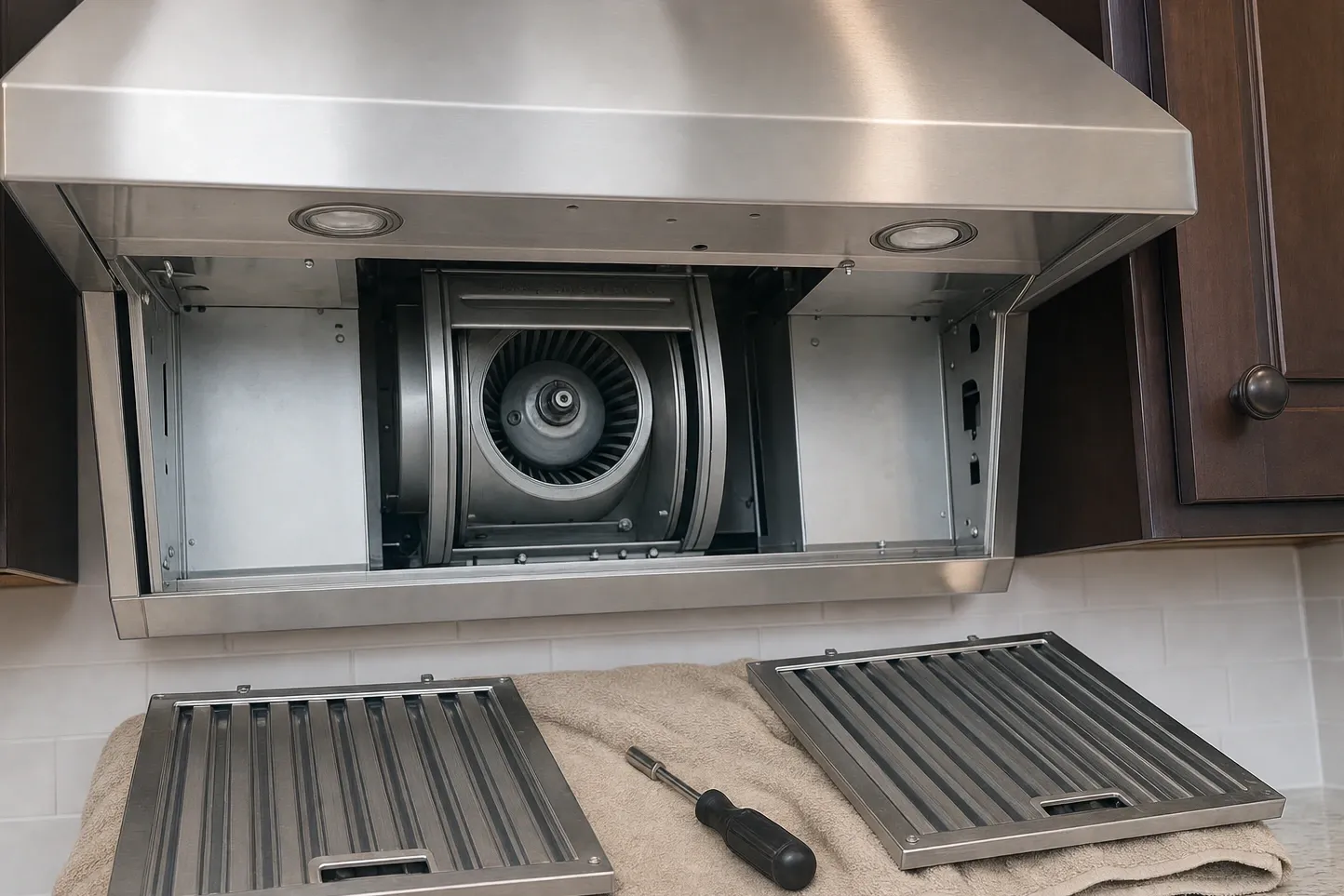
What this family covers
The canopy, the liner or insert behind it, the blower and its wheel, the speed control, the lamps, the baffle filters and the duct run above all of it. Ventilation is the one part of a Wolf kitchen where the fault is as often in the house as in the appliance — a crushed run, a damper that will not seat, a roof penetration doing something it should not — so these readings deliberately cover both, and say which is which.
The readings in this family
- Wolf Hood Filter Indicator It depends which Wolf canopy is overhead. A cooktop hood lights a filter symbol after roughly thirty hours of running; a V Series stainless or glass hood nearer one hundred; black glass shows FG.
- Wolf Hood Starts or Speeds Up by Itself Nothing prints. The evidence is behavioural — the blower rises during hard cooking and drops back later. For pro hoods Wolf publishes thresholds: exhaust above 200°F (95°C) to intervene, below 186°F (85°C) to restore the setting.
- Wolf Hood Controls Blink and Ignore Input On a V Series black glass canopy the character is FG, which Wolf notes is regularly misread as F6 — and says no F6 code exists. Pro hoods have knobs and no display.
Where these turn up in Denver
Ventilation faults in this metro split along the roofline. In the flat-roofed mid-century houses of the south-east, a hood duct goes straight up through the roof deck because there is no attic to run it through, and everything that follows — the curb, the jack, the damper, the cap — sits out in the weather with nothing above it.
In the newer subdivisions west and north, the duct instead runs a long horizontal distance to a sidewall, sometimes with more elbows than the blower was sized for. Wind loading on a foothills exposure then does to a sidewall cap what snowmelt does to a roof curb.
The indicator on the canopy cannot tell those apart. Reading what it does say, and when, usually can.
Follow-up questions
Does a filter indicator know how dirty my filters are?
No, and treating it as if it did is how a hood ends up smoking with a clean-looking light. A reminder of this kind counts hours of blower running and lights when the count is reached. Somebody who cooks twice a week and somebody who renders fat nightly get the same interval and need two completely different ones.
Why is cold air coming down the duct when the hood is off?
The backdraft damper at the termination is not seating. Grease stiffens the flap, the hinge corrodes, or debris props it open, and in a dry Denver winter the draught is immediate and obvious. It is also costing heat all season. That is an outside job at the termination, not a blower fault — call (303) 801-0060 to have it looked at.
Signed
Desmond Achebe
- Bench
- Cooking-appliance technician — controls and fault codes
- Years on the tools
- 11 years in the trade
- Reading here
- Filter reminders, heat response and controls that stop answering.
$89 service call
Give the model number and what the panel is doing.
Those two facts settle most of this on the phone. Wolf Repair Service Denver answers 24/7 on (303) 801-0060; the $89 visit fee comes off the repair once you approve it.