Denver · display faults
Wolf Oven Display Faults
An oven display fault is the control announcing that a reading it depends on — cavity temperature, latch position, fan rotation, the reply from a second board — came back outside the window it was built to accept. It names a circuit that disagreed, not a verdict on the oven. Wolf Repair Service Denver reads it against the model before quoting anything: (303) 801-0060.
What this family covers
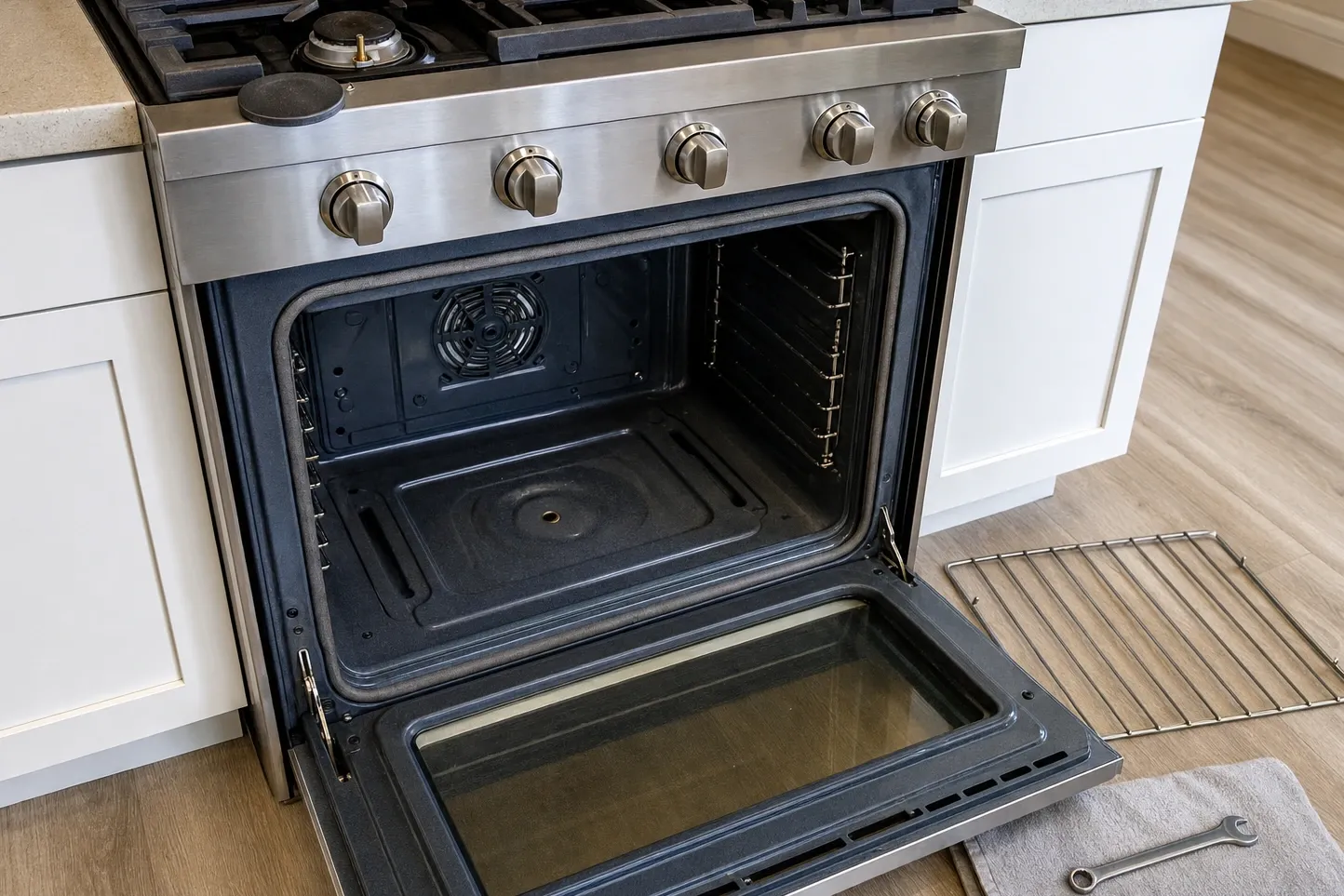
Everything behind the cavity door and the panel that drives it. Sensors and their calibration, the latch motor that holds a self-clean shut, the cooling fan that protects the electronics, the convection fan, the keypad, and the conversation between the user interface and the relay board underneath. Numbered codes exist on some Wolf generations and not on others, and the same number does not always mean the same thing across them, so each reading here is named for the state a cook can see and a code is printed only where Wolf's own documentation ties it to a generation.
The readings in this family
- Wolf Oven Door Lock Fault (ERR 01 on legacy dual fuel) On most Wolf generations, nothing: the door will not open and the panel carries on as before. On a legacy Wolf dual fuel range the control prints ERR 01, which Wolf's answer page calls the door lock switches not being sensed while the lock motor drives.
- Wolf Oven Temperature Sensor Fault It differs by generation. Some panels stop at a fault message and refuse every mode; others hold a setpoint that never arrives. The current dual fuel range guide lists an oven temperature issue with no number printed beside it.
- Wolf Oven Never Finishes Preheating Usually nothing but a setpoint and a rising figure that settles below it. Where the climbing temperature is shown it simply sits; where it is not, the only sign is a chime that never comes.
- Wolf Oven Probe Error A probe temperature that will not set, a reading pinned at one extreme, or a prompt asking for a probe already plugged in. Wolf has the panel chime five degrees below target, so a roast finishing in silence belongs here too.
- Wolf Oven Cooling Fan Fault Rarely anything. This one is heard rather than read: a fan that never spins up, or one running on and worrying an owner although Wolf says it should. A control cooked by a stopped fan shows other faults later.
- Wolf Oven Over-Temperature Shutdown Heat that stops with the panel still lit, sometimes with a message and sometimes with nothing but a cooling cavity. Wolf's troubleshooting lists an error shown on the panel as its own entry, answered by service rather than a reset.
- Wolf Oven Keypad or Stuck-Key Fault A panel that will not answer, sounds one tone over and over, or lights a function and holds it. Wolf's troubleshooting treats no response from the control panel as its own entry, cleared at the breaker.
- Wolf Oven Control Communication Fault Any combination that does not add up: a lit panel over a cold cavity, a message returning the moment power does, a knob display dark while the touchscreen still works. Wolf lists an error shown on the control panel as a service matter rather than a reset.
- Wolf Self-Clean Will Not Start A panel accepting Clean and then simply sitting, a rack prompt left unanswered, or a door that never locks. Wolf notes that on a double oven the second cavity is unavailable for the whole of the cycle.
Where these turn up in Denver
Denver kitchens put two unusual loads on an oven control. The first is the dry winter air, which shrinks door gaskets and lets heat past the seal: the control compensates by running the element harder, the cavity swings wider, and a temperature reading eventually falls outside the window the board accepts.
The second is the grid. Summer storms across the Front Range bring short interruptions rather than long outages, and a control that loses power for a second or two behaves differently from one switched off properly at the breaker. Clocks stop, lock settings revert, and a half-finished clean cycle can leave a latch part way between its two switches.
Neither is a reason to replace a control board. Both are reasons to read what the panel actually reported before anybody orders one.
Follow-up questions
Does a Wolf oven always show a number when something is wrong?
No. Some generations print a numbered code, others show only a symbol, a flashing setpoint or nothing at all beyond behaviour. A silent panel with a cold cavity is as much a fault report as a number is. Describe what the oven did rather than hunting for a code, and Wolf Repair Service Denver can usually place it on the phone.
Can a fault clear itself if the oven is left alone?
Sometimes, and that is the trap. A latch that finally reaches home, a cooling fan that catches after a pause, a board that recovers on a power cycle — all of them look like the problem going away. The underlying part is usually still marginal, and an intermittent fault is the one worth booking early on (303) 801-0060.
Signed
Desmond Achebe
- Bench
- Cooking-appliance technician — controls and fault codes
- Years on the tools
- 11 years in the trade
- Reading here
- Sensors, fans, the latch and the control behind the oven cavity.
$89 service call
Give the model number and what the panel is doing.
Those two facts settle most of this on the phone. Wolf Repair Service Denver answers 24/7 on (303) 801-0060; the $89 visit fee comes off the repair once you approve it.