Wolf Hood Starts or Speeds Up by Itself
On the panel
Nothing prints. The evidence is behavioural — the blower rises during hard cooking and drops back later. For pro hoods Wolf publishes thresholds: exhaust above 200°F (95°C) to intervene, below 186°F (85°C) to restore the setting.
A hood starting or gaining speed with nobody at the controls is obeying a heat sensor. Wolf's pro ventilation guide calls it heat sentry: past a set exhaust temperature it brings the blower on or raises its speed, then hands it back on cooling. Ask Wolf Repair Service Denver which canopy has one.
How to read it
Normal · Watch · Call
| Reading | What it looks like |
|---|---|
| Normal The appliance behaving as designed | The blower climbing while something sears underneath and settling again afterwards. On a canopy carrying the sensor, that is the feature working. |
| Watch Worth noting, not worth a visit yet | A step-up during genuinely light cooking, or a blower taking far longer than it used to before handing the speed back. |
| Call Stop and book the diagnosis | Speed changing on a model Wolf says has no heat sensor, the VW and VI cooktop hoods, or a blower running in a cold kitchen. |
What you can check yourself
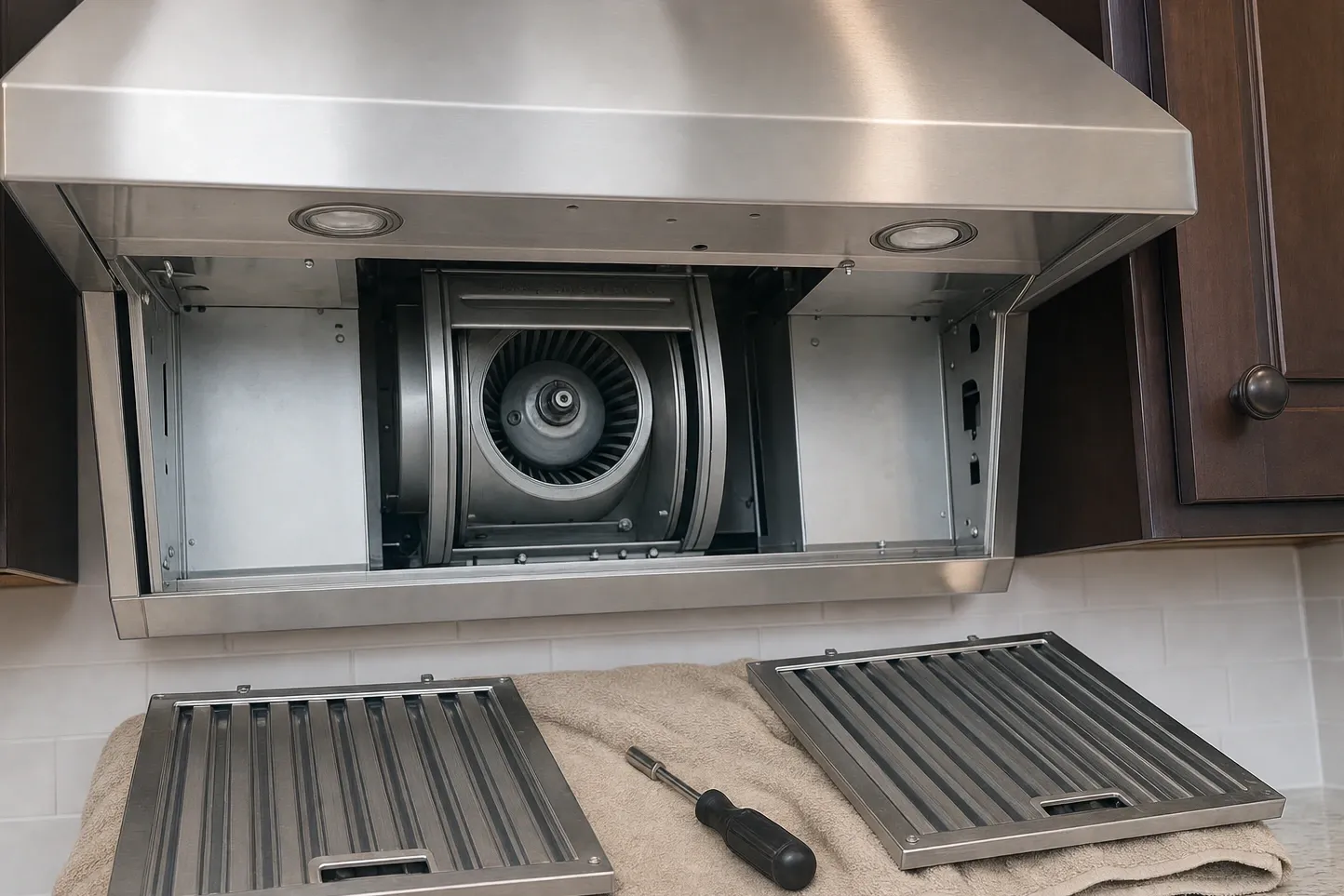
- Check the model letters on the rating plate inside the hood shell: Wolf gives this sensor to CT wall, CT island, CTE, PL, PW, PWC and PI hoods.
- Wash the filters. Restricted air keeps exhaust temperature up, and that is what the sensor reads.
- Notice what triggers it. A griddle or a rangetop run wide open puts real heat underneath.
- Switch the hood off at the breaker if it will not settle, and stop there.
- Stop there. Anything behind a panel, a sealed burner or a gas fitting is the visit, not the evening: Wolf Repair Service Denver, (303) 801-0060.
What the visit consists of
A visit reads the sensor and the speed control together, because a thermostat drifted low and a board that lost a step complain identically. Blower wheel and duct go with them, since both change what the sensor reads.
What it costs to put right
Ventilation controls sit outside the six bands quoted in advance here, so this one is priced once the cause is established. The service call is $89 flat. It buys the trip and a finished diagnosis, and it comes off the repair price the moment you say go ahead.
Why it happens in Denver kitchens
A sensor reading exhaust temperature is reading the duct as much as the cooktop. Suburban kitchens south and west of here often send a canopy a long way to a sidewall cap, with more elbows than the blower was sized for. Slower air leaves heat under the canopy.
Follow-up questions
Can the heat sensor be switched off?
Not by an owner, and it is not meant to be. It exists so a canopy over serious heat clears the air whether or not anybody reached for the knob. What can be changed is the reason it keeps firing: clean filters and an open duct let exhaust cool before the sensor ever sees it.
Does every Wolf hood behave this way?
No. Wolf gives the heat sensor to its cooktop wall, island and low profile canopies and to the pro liners, wall, chimney and island hoods, and says outright that the VW and VI cooktop models do not have one. On either of those, speed changing alone is a fault.
Signed
Desmond Achebe
- Bench
- Cooking-appliance technician — controls and fault codes
- Years on the tools
- 11 years in the trade
- Reading here
- Reading: hood lights and indicators
$89 service call
Give the model number and what the panel is doing.
Those two facts settle most of this on the phone. Wolf Repair Service Denver answers 24/7 on (303) 801-0060; the $89 visit fee comes off the repair once you approve it.