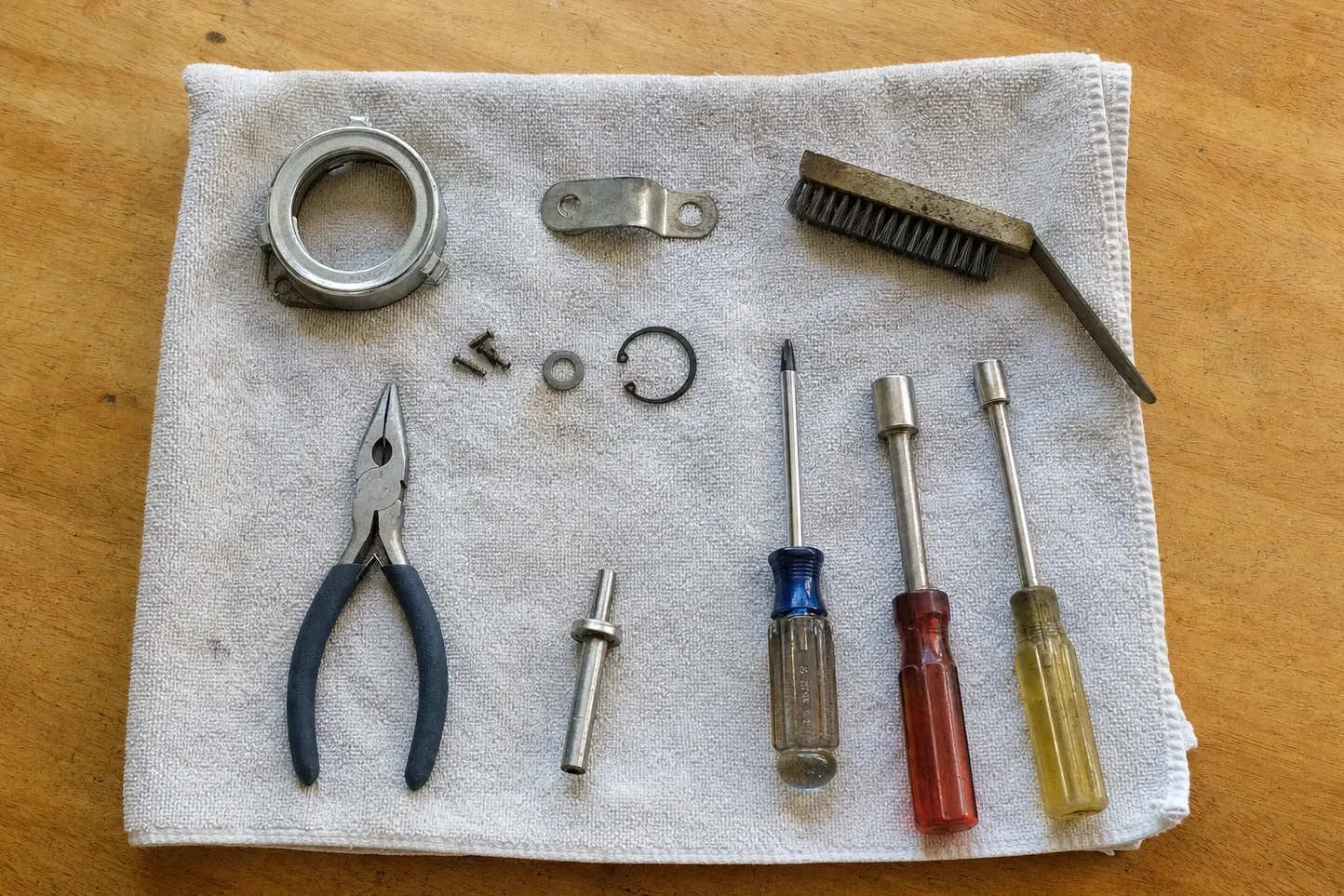
Oven Repair
Wolf oven reads 375 and bakes like 340: finding the drift
A Wolf oven that claims one temperature and delivers another is usually a sensor, a calibration nobody set, or a door that stopped sealing. How to tell which, and what a mile of altitude changes about the baking itself.
Signed
Desmond Achebe
- Bench
- Cooking-appliance technician — controls and fault codes
- Years on the tools
- 11 years in the trade
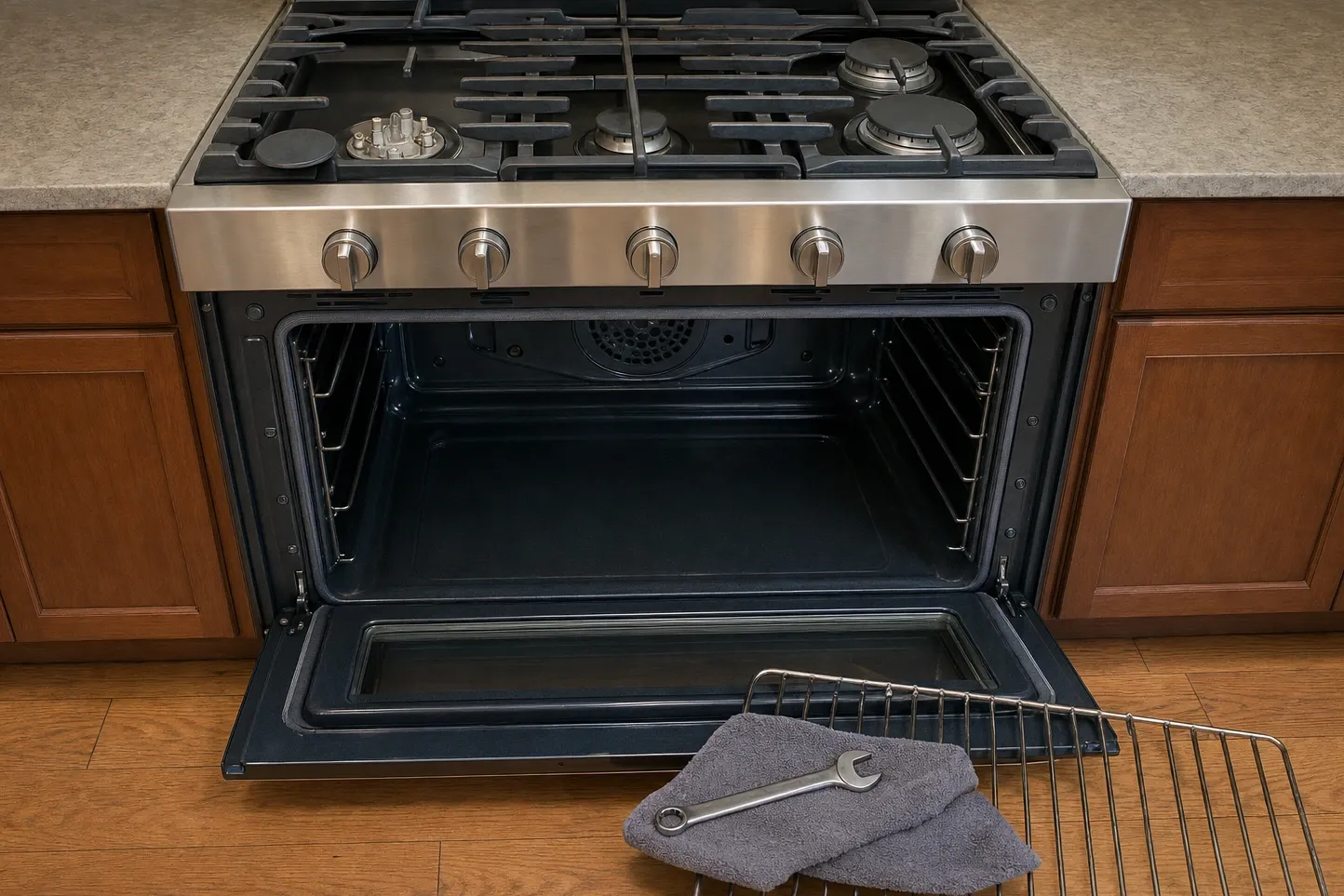
Display says 375; the middle rack holds 340. That complaint keeps a Denver bench as busy as any other oven fault, and it is also the one where the appliance turns out to be blameless more often than not. So nothing gets replaced until the drift has been measured properly — a drifting sensor, a control nobody ever calibrated and a door that stopped sealing are three separate visits carrying three separate parts.
First, prove the drift is real
Put a probe thermometer on the middle rack, in the centre, with nothing else in the cavity. Shut the door. Call for 350, then walk away: the reading that counts comes twenty-five minutes past the preheat tone, not at it, and the door stays shut for every one of those minutes.
That last instruction is the one people skip, and it is why so many ovens get diagnosed wrongly. An oven does not sit at one temperature; it cycles above and below the set point by design, often by twenty degrees either way. Reading it once, thirty seconds after the tone, tells you where in the cycle you happened to look — not what the oven is doing. Take three readings across ten minutes and average them.
If the average is within about fifteen degrees of the set point, the oven is behaving normally and the problem is in the recipe, the rack position, or the pan. If it is consistently twenty-five degrees or more out, there is something to fix.
What a real sensor fault looks like
The temperature sensor in a Wolf oven is a resistance probe — a thin rod poking into the cavity, usually top left or top rear. Its resistance rises predictably with heat, and the control reads that resistance as a temperature. When the probe drifts, it does not fail cleanly. It reads plausibly but wrongly, and it usually reads low resistance, which the control interprets as cooler than reality.
Three signs point at the sensor rather than anything else:
- The error grows with heat. Ten degrees out at 250, forty out at 450.
- The oven overshoots badly on preheat, then settles somewhere odd.
- The error is the same on every rack, top and bottom alike.
A technician confirms it by reading the probe cold, at a known room temperature, and comparing against the resistance the model expects. That reading takes two minutes and it settles the argument. Guessing at it — and swapping the part because the symptom sounds right — is how a customer ends up paying for a sensor and still having a cold oven.
The door is the other half of the story
Denver’s winter air is dry enough to matter here. A door gasket that spends five winters at ten percent humidity goes stiff, and a stiff gasket stops taking up the small misalignments a heavy door develops. What you get is not a dramatic leak but a slow one: heat crawling out along the top edge, the element running more often to make up for it, and the top of everything browning while the middle lags.
Two checks, neither of which needs tools. Cold oven, door shut: look along the top edge from the side and see whether the gap is even from one end to the other. Then open the door halfway and let go — it should stay where you put it. A door that sags shut or drifts open has tired hinge springs, and slack springs stop pulling the door square against the gasket long before the door falls off.
Hinge springs and gaskets are ordinary parts. What matters is fitting them as a pair; a new gasket against slack springs compresses unevenly and is flattened again inside a year.
Why convection changes the diagnosis
If your Wolf has convection and the drift only shows up in convection mode, stop looking at the sensor. A convection fan that has lost speed — dry bearing, or a blade clipping the shroud — moves less air, and less air means the cavity stratifies. The sensor sits in one place and reads it correctly; the rack two positions down is simply not getting the same heat.
The tell is sound. A tired convection motor is audible before it is measurable: a rising whine at high heat, or a rhythmic tick as a blade brushes its housing. If you can hear the fan change note during a bake, the fan is the fault, and no amount of calibration will help.
Steam ovens add one more Denver-specific item. City water here is hard enough to fur up an inlet valve and a boiler, and a scaled boiler cannot make steam fast enough to hold a set temperature. That shows up as a combi cycle that reads low and never recovers, usually with a code attached.
When it is worth calling, and what to have ready
Some of this you can settle yourself in an afternoon: the probe test, the door gap, the hinge-spring drop test, and listening to the fan. If the oven is within fifteen degrees, the honest answer is that nothing needs repairing and the recipe needs the altitude adjustment instead.
Call when the measured average is more than twenty-five degrees out and steady, when the error scales with temperature, when the door gap is visibly uneven, or when the fan has changed its note. Have the model number ready — behind the door on the frame, or on the plate at the bottom of the cavity — plus the three probe readings you took and the rack you took them on. That handful of facts is often enough to know which part is coming out to the van before anyone knocks on the door.
Follow-up questions
Can I recalibrate a Wolf oven myself?
On most control panels, yes — there is an offset setting, usually reachable by holding the bake or mode key while the oven is off. Set the offset only after measuring with a probe on the middle rack over three full cycles. If the offset needed is larger than about 35 degrees, the fault is a sensor or an element, and dialling in an offset just hides it.
Why does my baking fail here even when the oven is accurate?
At 5,280 feet water boils around 202F and batters rise faster and set later. Cakes climb and collapse, breads over-prove, and custards weep. Denver bakers usually raise the oven 15 to 25 degrees, shorten the time, and cut the leavening slightly. That is a recipe problem, not an appliance fault, and no repair changes it.
How much does an oven thermometer need to cost to be useful?
Not much, but it needs to be a probe you can leave in place with the door shut, and you need to read it at the same rack position every time. A dial thermometer hanging off a rack edge, read through the glass while the door is open, is the single most common reason someone calls convinced their oven is thirty degrees out when it is fine.