Range Repair
Booking a Wolf Installer or Technician: What to Check First
Contact Wolf or your dealer to confirm an installer is Wolf-certified, because a logo on a van proves nothing. Then ask about gas setup at altitude, warranty parts and the rating plate before anyone in Denver touches your range.
Signed
Desmond Achebe
- Bench
- Cooking-appliance technician — controls and fault codes
- Years on the tools
- 11 years in the trade
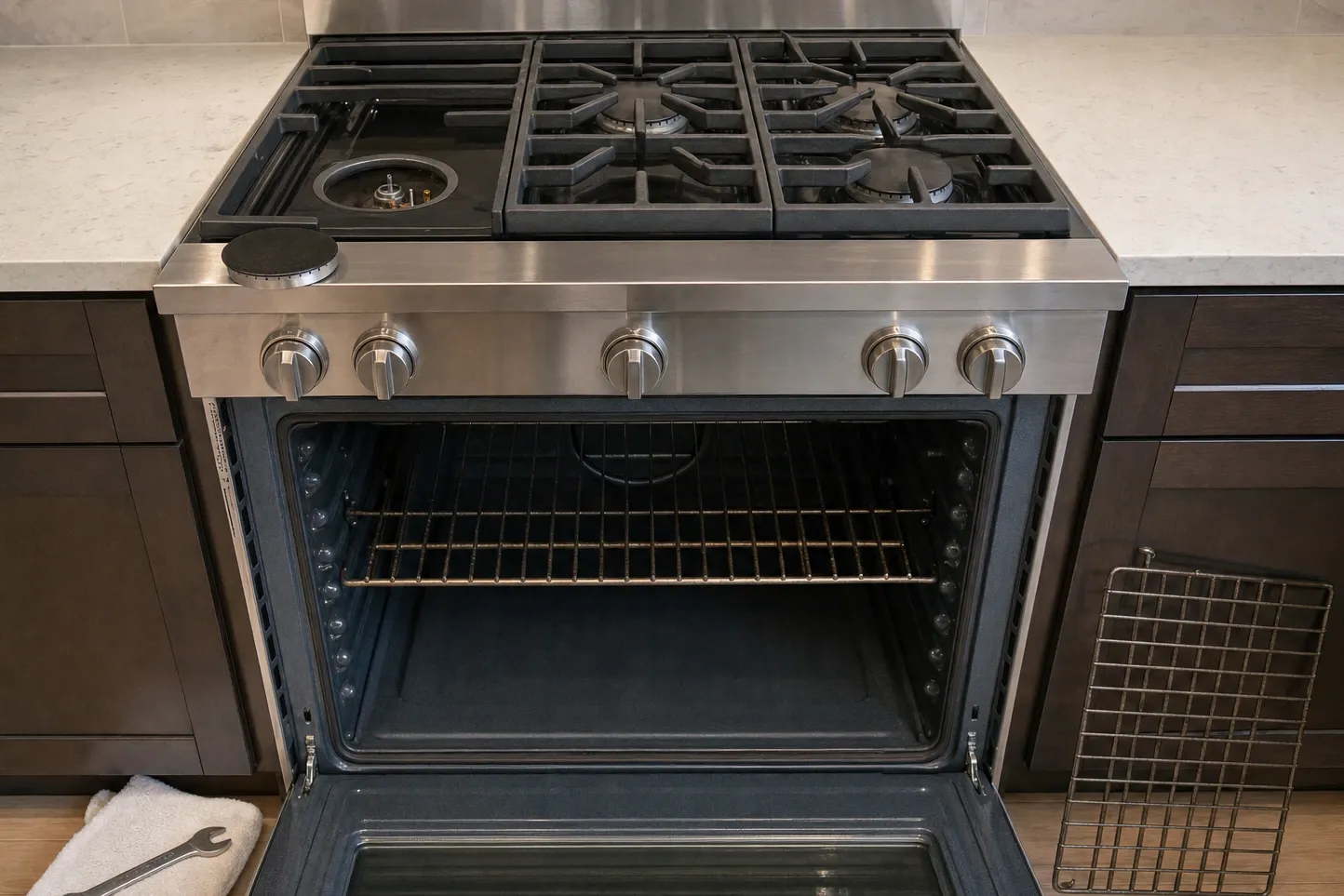
Contact Wolf and ask which nearby companies are certified installers or service providers for its cooking products; its customer care team can answer that, and a decal on a van, a badge on a website or a confident voice on the phone cannot. The dealer who sold you the range, wall oven or cooktop is the other trustworthy source, since dealers usually arrange installation through crews they already work with. Make that call before you book anyone, and have your model and serial number in front of you. Here in Denver the stakes are a little higher than at sea level, because a gas appliance sitting about a mile up burns in thinner air, and a sloppy setup or a wrong diagnosis on a pro-style range is costly to undo.
What the word means, and where to check it
When Wolf refers to a company as certified, it means that company is part of Wolf’s own service network, the group it routes warranty jobs to and supplies with parts directly. Anyone can print a brand name on a truck, so treat logos, wrapped vans and search-ad wording as advertising rather than evidence. The check takes a few minutes: phone Wolf or use the service finder on its website, enter your address and model, and see whether the company you were about to hire shows up.
Installation and repair are often different people. Many Wolf installs are arranged by the selling dealer, while repairs years later go to whichever company the owner chooses. If something has been wrong since day one, such as a door that never sat square or a burner that always lit late, ask the dealer who handled the install and start there.
Why it matters while the warranty is running
Wolf’s residential coverage comes in two layers. For the first two years from the date of original installation, it is a full warranty: any part that turns out defective in materials or workmanship under normal home use is covered, parts and labor both. From then until year five, a limited warranty still pays for a short list of costly components, namely the burners on gas models, the heating elements on electric ones, the control electronics, the blower motor in a hood, and the magnetron or induction generator where the product has one, but you carry the labor and every other cost.
That second layer is where your choice of technician starts to cost or save money. If you use a company outside Wolf’s network, Wolf expects you to contact it for the covered part, and it will not refund a part your tech bought from another supplier. An independent shop that orders a board on its own account may hand you an invoice Wolf will never reimburse. During years one and two, going through Wolf is usually the sensible call. In years three to five, ask any company exactly how it plans to source a covered part before you say yes.
Two small details trip people up. Wolf honors these terms for homes rather than businesses, inside the US or one of the Canadian provinces, and a scratch or blemish on a stainless or manufacturer-provided powder-coated door is covered for only 60 days, so inspect the finish carefully in the first weeks.
Have this ready before the first phone call
Any capable company, on the network or not, will want the same handful of facts. Gather them first:
- The model and serial number from the rating plate, the tag Wolf’s diagrams call by that name. It also shows the total amps, and on some units the manufacture date.
- The installation date and the dealer’s name, which Wolf asks for on any warranty claim.
- The fuel type: natural gas or LP, and whether the appliance has ever been converted.
- Any past temperature adjustment. An offset changes every cooking mode at once, so the technician needs to know about it before chasing a baking complaint.
- A plain description of the fault: what happens, when it started, and what you have already tried.
Registering the appliance online or in the Sub-Zero Group Owner’s App keeps most of this in one place, which saves a scramble when something stops working on a holiday weekend.
Gas conversions and mile-high setup
Wolf recommends that a service technician handle any switch between natural gas and LP. For the dual-fuel models numbered DF3050 up to DF6050, moving to propane takes kit 829533, while returning to the utility supply takes kit 829536. Once a range runs on propane, the griddle is the single part that gives up heat, about 2,000 Btu less. A tech who knows these ranges will name the right kit without hunting for it. Conversions tend to come up when a range moves between a propane-fed mountain cabin and a city kitchen on the utility line.
Elevation is the other local wrinkle. A mile above sea level the air carries less oxygen, so a gas flame behaves differently, and installation instructions for gas cooking appliances generally include a high-altitude section. Ask whoever installs or services your range whether that section applies to your model, and whether they looked at the flame on every burner before leaving.
Sizing up a company before it arrives
Put these to any company on the first call:
- How often do you work on Wolf ranges, wall ovens and cooktops, and on my exact type?
- Do you diagnose before quoting, and is the visit fee credited toward the repair?
- Where do your parts come from, and what happens if the part is still inside Wolf’s five-year coverage?
- Will I see the diagnosis and the price in writing before work begins?
Warning signs:
- A firm repair price given over the phone before anyone has looked at the appliance.
- A push to replace the control board first on a fault that only comes and goes.
- Brand-status claims that fall apart when you check with Wolf.
- Advice to line the oven floor with foil or rest pans on it. Wolf’s care guide for its M Series ovens says both damage the porcelain interior and void the warranty.
Where an independent repair service fits
Wolf Repair Service Denver is an independent service that is not affiliated with Wolf, and we are not manufacturer-authorized. For an appliance still inside its first two years, the honest advice is to call Wolf first, because that repair costs you nothing there. Past that point, owners in the Golden Triangle, Five Points, Virginia Village and Belcaro often want a second opinion or a visit that fits their own week; you can see the neighborhoods we cover or call (303) 801-0060.
Our service call is $89 flat. It covers the trip and a finished diagnosis, and it comes off the repair price once you approve the work. Typical ranges after diagnosis are $180–$470 for an igniter or spark module, $240–$580 for burner valve or orifice service, and $420–$870 for a control board or touch panel; the firm number follows the diagnosis, never before it. Because replacing a pro-style range costs far more than almost any single part, one worn component is rarely a good reason to start shopping for a new one.
Follow-up questions
How can I tell if an installer is on Wolf's own service network?
Ask Wolf, not the installer. Call Wolf's customer care team or use the service finder on its website, give your address and model number, and see whether the company you were about to book appears. The dealer who sold the appliance can usually tell you the same thing. A truck wrap, a website badge or a search ad is marketing, not proof.
Will hiring an independent technician affect my Wolf warranty?
It changes how covered parts reach you rather than cancelling coverage. Wolf's written terms say an owner who uses service outside its network must contact Wolf to receive repaired or replacement parts, and Wolf will not pay back the cost of parts bought from other sources. In the first two years, when labor is covered too, going through Wolf is normally the cheaper path.
What does the $89 service call pay for?
It pays for the trip and a complete diagnosis, with the cause named and a firm price for the repair. If you decide to go ahead, the $89 is subtracted from that repair bill, so you are not paying for the visit twice. If you decide not to, you still keep the diagnosis.
Should a technician recalibrate my Wolf oven on the first visit?
Usually not. Wolf describes oven temperature calibration as possible but seldom needed, and says it should be done by its own service network. Because an offset moves every cooking mode at once, tell whoever comes out if anyone has adjusted it before, so they test the oven against a known starting point instead of stacking a second correction on the first.
My Wolf burner keeps clicking but will not light. Do I need a technician?
Not always, so try the simple checks first. Let the burner area dry completely after a spill or a wipe-down, seat the cap flat on its base, and keep the small spark tip clean. If it still clicks without lighting, or clicks after the knob is off, the igniter or spark module may need service, typically $180–$470 once diagnosed.